I think we’re all familiar with the term ‘hackers’ and the horrors that sometimes comes with it. The thought process of “did that ad from a week ago let someone into my computer?” or “was that text really from telstra or was it someone trying to manipulate me into opening a dodgy link”. Imagine if you knew someone was watching your every move on their computer. Well, believe it or not, in some cases this is true and it’s not knew either. Hackers have been around for decades, starting all the way back in the 1970s (the first major hack) when John Draper figured out a way to make free phone calls, later known as “Phreaking”.
I originally wanted to focus on the history and development of hackers over time, however, then I came across the story of Marian Rejewski and his part in ending WWII through encoding and hacking in the Nazi Cipher called the enigma. Nowadays, when we think of the term ‘hacking’ we think of bad people diving deep into our private information, gaining access to everything we once shared on the internet (yes that includes that embarrassing video star you posted to instagram at age 11) and holding all control over our technology. It’s scary right! Well, Marian Rejewski provided hacking for good and not evil…. let me explain. Rejewski was a Polish mathematician and cryptologist who was apart of the team who helped to encrypt the enigma and turn the codes in messages. It’s kind of a hard and long process so I won’t make you sit here and watch me recite it… cause 1. that’s copyright, and 2. it’s too long. However, I will provide a link into the finest details into how Rejewksi did this..https://culture.pl/en/article/the-hacker-who-saved-thirty-million-lives
In the end, Rejewski was responsible for rewiring the keys, although there were hundreds thousands of different combinations, until, he came across the alphabetical order, which came out in plain writing. He’s cracked it! Saving thirty million people!
Over the course of this semester our following has increased to around 112 followers. Our feedback has been nothing but supportive and reassuring, with our users starting a conversation to share their ideas, opinions, or even gratitude for something we shared. A few weeks back I took a much needed mental health day which I documented on Tik Tok. This video ensured I not only took care of myself but that I was sharing relatable content to my audience demonstrating the importance of mental health days. This video reached over 275 views and gained likes from strangers where it reached their page. We believe Tik Tok can be another avenue we can take our DA by making videos that are helpful, wholesome, or reflect our own struggles and how we overcame them
We’ve incorporated topics such as online learning, awareness surrounding mental health, mental health stigmas, our lack of attention/motivation, and the importance of mental health days, initiating conversations and bringing awareness to these topics. Linking to the weekly topics as closely as we can. We’ve chosen to curate content surrounding topics that impact us personally and is something we feel passionate about, as we experience them ourselves. Everything we post holds a special meaning to us in one way or another, and this is why we enjoy the content we curate and having the audience we do, helps to encourage and reassure what we curate is on the right track. It’s important for us that our content is relatable, and open, as it ensures this friendly and vulnerable relationship is built between us and our audience.
We’ve had our challenges but reframing our perspective of not dwelling on what’s gone wrong but how we can fix it, has played a huge role in Calming core’s success. I’m excited to see what we can do next as we continue this journey with everyone.
I’m not going to lie… since we have been given this task, I have been stuck on ideas and I’m not having much luck. I know I want to focus on the entertainment industry as part of the attention economy and how different entertainment platforms are fighting for our attention. We are so consumed with what we have access to such as Netflix, Tik Tok, Stan etc. that our brain can no longer stay attached to one platform at once. For instance, when I talked to my friends about this idea, we all agreed that when we put on something like Netflix or YouTube, without realising, we are on our phones scrolling through Tik Tok or instagram. Why is this? Well according to an article by ‘strategy+business‘ “The growth of entertainment has produced intense global media competition in which victory lies in momentarily capturing the fleeting, fickle attention of consumers.”
For this assessment I want to demonstrate the over consumption of entertainment due to this ‘global media competition’ and how it influences us in our daily lives. This is where I have struggled the most. Every idea I have had so far has been over complex and not something I have loved. I want to stick with this media idea but am unsure as to how I can portray it effectively and successfully. Although, I have drawn up some possible frames:
Another way I was thinking of doing this, was to create a dysfunctional story of a day in the life of a uni student or even just an adolescent and how they are consumed by media. I feel with this concept I can incorporate a meaningful message, my original ideas, but also allows room for me to play around with concepts we have discussed in class this semester. In this story, I can display from the moment she/he/they wake up, the connectivity and attraction we have to our phones and our media. The hardest part about this idea is gathering the media from all forms and referencing them. With my original plan, hundreds of different clips with be needed to be resources from various platforms…. that is a lot of referencing.
My next step is to draw up frames and possible even create a storyboard where I can design each scene and layout my story. I feel this ‘attention economy’ concept as well with my current idea will allow me to play around with new editing techniques… however, another problem arises where my shots need a platform like adobe premiere pro, which I don’t have. Over the next week or so, I hope to have a laid out story and to begin filming.
Nowadays, memes have turned from meaningless images used to represent humour or a joke, to propaganda for such cases as political campaigns or protests.. etc. I admit, when I used to hear the word “meme” I would automatically laugh and think of an image with a funny caption, but as my knowledge grows and I’m introduced to more concepts such as ‘meme warfare’ I’m understanding just how powerful and influential memes really are. Memes are now used as strategy to spread important information or to represent a certain opinion, it can also be dangerous as it can also be used to spread false news or rumours.
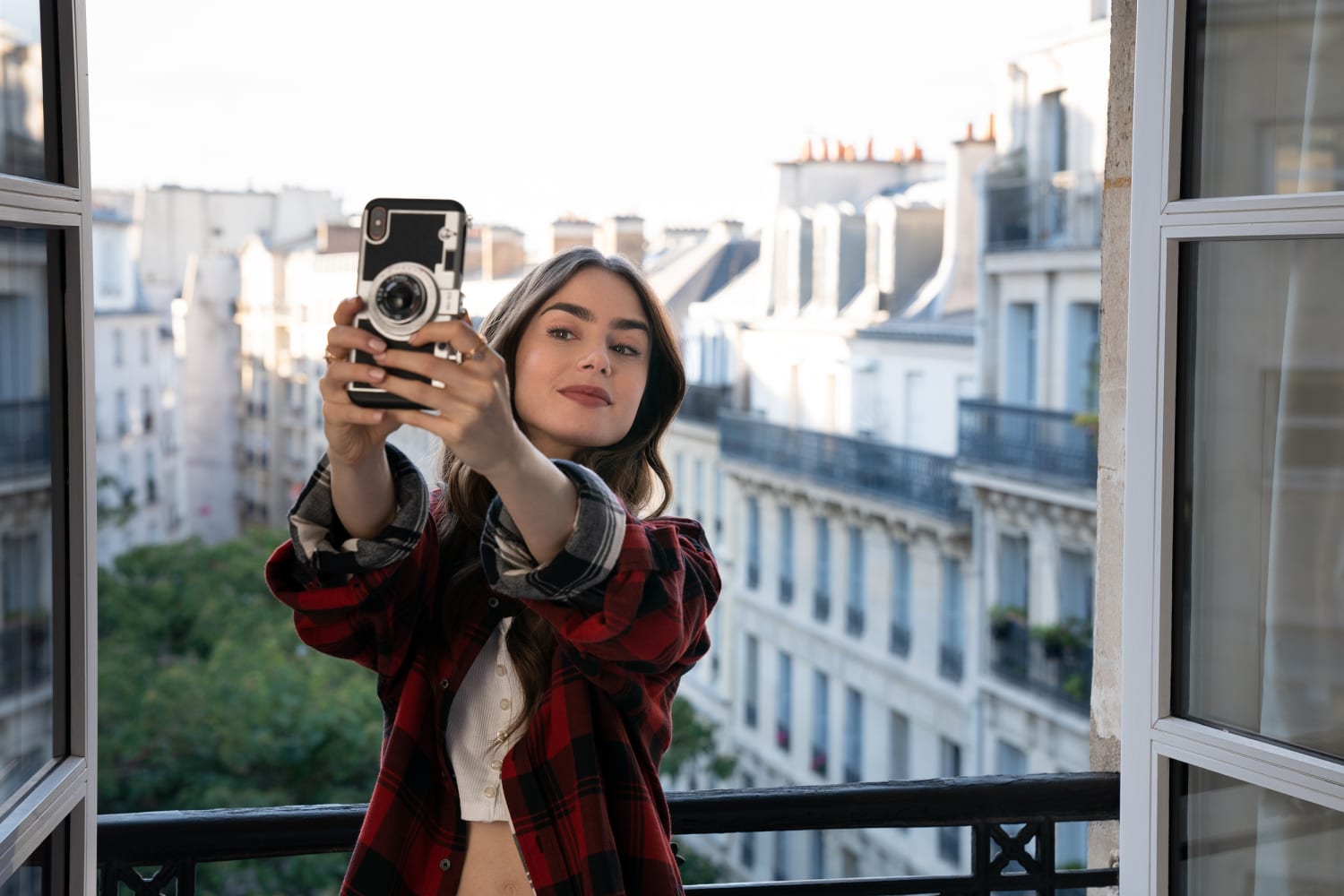
As someone who doesn’t have much interest in politics I wanted to present an example that suited both my interests but was also something that linked with the topic of meme warfare. A new TV series ‘Emily In Paris’ starring actress Lilly Collins has just been released on to Netflix. In this series Emily works for a marketing firm in Paris, where one of her first clients was a product for women. Long story short, Emily created a meme about this product that sent a sexist message about the name of the product and how it objectified women by men. This meme went viral and caught the attention of influential and important people, who in turn also shared this meme to their social media platforms. As the series goes on, this meme is brought up multiple times by other influential and successful people. In one scene in S1 E5 Emily, a small name in contrast to everyone around her at this party, is picked out from a room full of influencers with millions of followers, due to this meme she posted about this specific product.
“You created a meme using the Vaga-Jeune post. You even got Brigitte Macron to retweet you”
The original meme
The retweet
It demonstrates the power memes have as propaganda and how meme warfare is used to spread information or a certain view and therefore can alter others perceptions.
In order to send a message from one corner of the internet to another, the protocols of communication demand that the whole message be copied along the way several times. The digital economy is thus run on a river of copies”
Looking at this remediation you’re probably confused…
In medieval times the term ‘feudalism’ was representative of the combining of the “legal, economic, military, and cultural customs that flourished in Medieval Europe between the 9th and 15th centuries”. An example of this system is the relationship between lords and peasants, where peasants who were ‘nominally’ free could own land, but, the lord controlled all aspects of land use.
Well, feudalism has stayed relevant throughout time, and is still relevant today in the 21st century, however, in a very different form. As a society fuelled by technology, it only makes sense that feudalism is now present in the media industry, an example being the FAANG walled garden. Now the remediation will hopefully start making sense.
FAANG stands for; Facebook, Amazon, Apple, Netflix, and Google.
As users of these programs, which let’s admit we all are of at least one, we are representative of the ‘peasants’.. rough right. Where these programs are considered the ‘Lords’. In the world we currently live in, these media conglomerates act as feudal lords, who hold control over how we interact with content, and turn a profit, even if we are using them freely.
In other words, “In the advertising world, one who owns the audience data can decide the game rules, establish advertising prices and even influence data regulations” (Ivan Guzenko).
At the beginning of this semester I was adamant to create a page surrounding anxiety and ways I have found to cope with anxiety at home. I wasn’t sure exactly how to do it, but one thing that stuck with me was FEFO and the idea that failing was a normal process. The idea of being vulnerable and providing my audience with my own experience terrified me, but I knew my own experiences and being vulnerable is what makes this project what it is.
At the beginning, Lili and I worked tirelessly to come up with the perfect name and theme. We surrounded our project around this main idea of ‘calmness’ and creating a space people can come to for openness, learning others experiences, and to experience new and creative ways to help themselves whenever they are in a tough situation. Our idea worked well with the concept FIST (Fast, Inexpensive, Simple, Tiny) as it’s already something we deal with everyday.
Audience:
Defining our audience, I believe, was one of the hardest parts of this process. People who suffer from anxiety or experience overwhelming stress don’t have one particular look, we are very sparse, unique, but we share a common feeling. As a community, we focused on building a starter pack that portrayed the common interests or feelings between us and our audience. Due to this idea of ‘framing’ and ‘reframing’ our audience starter pack went from this:
to this:
We focused on identifying ourselves, and as our page grew so did our knowledge of who our audience was. Our audience are people who feel scared, alone, and confused. They don’t feel in control and are searching for natural ways that don’t ‘cure’ but they help to calm ourselves down and to help cope with the emotions that can overwhelm our body and minds.
Feedback:
Over this process we have received various amounts of feedback across all media platforms. Our most recent feedback came from ‘R U OK day’ where we used our platforms to start a conversation surrounding anxiety. We did this through sharing a post, as well as engaging with our audience through instagram stories where we reached out to our audience to provide some insight into the biggest advice that was given to them, and we shared their responses via instagram stories anonymously. This was to provoke our audiences to engage with each other and to help each other anonymously…we plan to continue this sort of engagement further and hopefully increase audience engagement.
We have learnt the best way to engage with our audience to keep our page as realistic and relatable as we strive to curate, is via instagram stories. We have done heavy research into what works best in order to keep audience interaction, and articles such as ‘Increase Your Instagram Engagement in 8 Easy Steps‘ by Caitlin Hughes has been extremely informative and provides points that we have been attempting to try.
Just a few messages we have received ^^^
Collaborations:
We have so far featured in the Chàe media magazine which was a lot of fun to be involved in.
We are hoping that throughout this semester we can have more engagement with other accounts and possibly be involved in more collaborations overtime.
What’s in the future?
As stated in the pitch we are hoping to expand our page onto a bigger platform such as a blog, but the time has not be right just yet. What I mean by this is, we want our audience to be invested in our page, to engage more, as well as we are hoping for a larger following. We want our blog to be the best it can be. Instagram a great place to start and to build an audience as well as creating a connection with our audience. However, as stated by in ‘The Blog Design’,
Even though talking in the long run, the audience base generated on the blogging website is more genuine as compared to social media platforms such as Instagram. The reason being, a blog is more accessible and useful to readers, so they will tend to visit the site regularly when they like the content.
As I am still only learning how to cope with anxiety, and as my anxiety grows worse, we are not only helping others with this page, but we are also helping ourselves. Coping with anxiety is not an easy task, it’s something that takes time, experimentation and a lot of mental strength. This is why we strive to be as honest and truthful as we can be, and also why we encourage our audience to provide their own insights. We are each on a path of learning and healing, and we are all doing it together. We still have so much work to do but I am super happy with what we have pulled off so far. I’m excited to see how much more we can do with this project.
You get into your pajamas, grab your favourite blanket, and make yourself comfortable on the couch. You scroll onto NetFlix and put on a movie you have been wanting to watch for ages… you’re excited. 5 minutes later, you find yourself scrolling through instagram… but you don’t know how you got there. You don’t remember opening up your phone to even be on instagram. Yeh, it happens to the best of us. But why is it so hard for us to concentrate on one thing at a time?
This is where the “attention economy” comes into play. As stated in “The Age of the Attention Economy Fueled by Social Media Addiction“, the attention economy “describes the supply and demand of a person’s attention. Although the abstract concept of attention is not immediately palpable, it is not much different from any other resource in that our personal supply is finite”.
A quote in this article that really stood out to me was one by Herbert Simon:
a wealth of information creates a poverty of attention and a need to allocate that attention efficiently among the overabundance of information sources that might consume it”
Herbert Simon
With all the information accessible to us at our fingertips, our minds are addicted to new knowledge and social media. This is because our social media and programs we use alter our news feed or ‘for you pages’ (Tik Tok), to fit our interests and to appeal to our specific likes and dislikes. The algorithm is altered for each unique individual, therefore, gaining their undivided attention. It fits our ‘niche’ as such.
From a young age my grandfather has been educating my family members and I on our ancestry. Every time I would go over I was shown photos, letters, and souvenirs from great grandparents and so on…. but when I was shown footage shot on 8mm film back in the 1930s I was in absolute awe.
As a lover of history watching film captured not only during that time period in the amazing condition the footage is in, but to also have it filmed by my own great grandparents is so special. So of course, when we were given the task to use found footage to create a film, I was inspired.
Originally shot on 8mm film, my great uncle got them digitalised by a professional who placed them on a DVD. My Pa being the talented man he is was able to gather this footage off the DVD and transfer over to his computer.
I wanted to modernise the footage by keeping the footage old but styling the music to fit this modern era. Using Ziggy Alberts ‘Days in the Sun’, I aimed to create an upbeat and beach aesthetic, as my great grandparents, Frank and Doris, loved the beach.
This footage is so special to me and my family as my grandmother speaks so fondly of her childhood and all the challenges they faced living in Manchester during the war, and here we can see it in film.
With the current pandemic and more people working from home, it’s easy to identify how flexible our working conditions are due to the introduction of new technology. We have continuous access to connectivity and reachability of both employee and employer simply through the ownership of our phones or computers. individuals can be reached from a workplace in their own homes or even whilst on holidays, which can be both a burden and blessing. It allows us to have the freedom of working from our own homes, but also shares the burden of limiting the freedom of having time away from work.
It once wasn’t like this, as there was a time when connectivity was a large more difficult to come by. A workplace used to follow a specific structure of set times, where whilst in this time period was the only time you would be working, a traditional workplace structure. Of course this structure is still in place in most cases, as I personally work in a job that has set hours. The difference is nowadays my manager can message me anytime and anywhere, if someone calls in sick and I need to fill in or so on… whereas many years ago this was not the case.
The shift is known as the ‘liquid labour’. With the technology we have available to us today, we as a community, are able to shift from at the workplace to online effectively and efficiently.
The convergence of the time and effort we invest in both production (‘work’) and consumption (‘life’) as signaled by Gershuny does suggest that our most common solution to the increasingly anxious and sometimes exciting developments in society is an endless individual and professional mixing of the cultures of working and living, thus indefinitely blurring the boundaries between them
Marke Deuze
I found this concept interesting because I have never taken the time to think about how lucky we are to have the access to the technology we have today that allows us to adapt as efficiently as we have. Covid-19 has been hard on so many businesses, and places of work, but having the option to work from home and still be able to make a living is so beneficial and encouraging.
This weeks lecture introduced us to a lot of new content, but what stuck out for me was the change from centralised networks to distributed/decentralised networks.
My remediation follows the journey a single message would take as it goes through a centralised and a decentralised network.
Centralised
Decentralised
Telephone and communication networks throughout the 20th century, were known as centralised networks…that was until the distributed network was introduced. A centralised system incorporates a mainframe where all messages are sent from point A, from their they are distributed to point B. With this network comes the downfall, that if something were go wrong, all systems and networks would be affected and no longer functionable. An example of this mainframe is the IBM AN/FSQ -7, a data processing system that acted as computers.
In 1964, Paul Baran came up with the ARPAnet concept which meant the network no longer has a central hub/mainframe. By removing the mainframe, each node is given a separate switch, therefore, more control, without the approval from a central switch. This changed the way communication worked by allowing the possibility that if something were to break, the network would still be functional.





 T's Timeline