
BCM111

Graceland 🎤

When I started looking into the topic cultural appropriation and culture appreciation, my dad told me about an album, released by Paul Simon, that he vividly remembers listening to during his HSC. In the album ‘Graceland’ Paul Simon used South African singers to create a political statement about Apartheid. Around this time, the U.N sanctioned South Africa over their oppression of black people. During this time countries from around the world boycotted playing international sport against all South African teams, like cricket, and rugby, their major sporting codes. There was also a call for musicians around the world to boycott touring or including South African artists also during this time.

Paul Simon on the other hand used black South Africans to create his blockbuster album ‘Graceland’ in 1986. He was first exposed to their magical music through voice, when his friend Heidi Berg gifted him a bootleg cassette tape during a tough time in both his career and personal life. On this cassette tape was “Gumboots: Accordion Jive Hits, Volume II — originating from either Ladysmith Black Mambazo or the Boyoyo Boys” (Camacho, 2016), which were later collaborators involved in ‘Graceland’. After an initial visit to South Africa, which was received poorly in many circles for political reasons, Simon completed his album in Abbey Road studios in London, June 1986. Two of the songs, ‘homeless’ and ‘Diamonds on the soles of her shoes’, had heavy collaboration with lady Smith and became focal hits for the album. The track ‘diamonds on the soles of her shoes’ had a large political meaning within its lyrics as it links back to the mining of zulu lands to find diamonds, the exploitation of the black people and the creation of the rich white society leading to a stronger apartheid.

In terms of cultural appropriation, the album Graceland can be seen as both an acceptable collaboration of south African cultural music as way to expose these artists to international stages, or on the other hand, can be seen as another exploitation of white using black culture for financial benefit. However, it is widely accepted that Simon collaborate with these musicians purely to expose their talents and cultural music to the world. In fact, in 1987, Paul Simon produced the group, Ladysmith black mambazo’s 1987 album Shakazulu, which was first released in America not South Africa. He had brought African music to the world, as stated by Jordan Runtagh in the article ‘Paul Simon’s ‘Graceland’: 10 things you didn’t know’, “white artist had been incorporating traditionally black music into their work for most of the 20th century. But Graceland was ground-breaking for wearing its influence for all to see”. Simon was determined to produce an album that demonstrated an equal collaboration between both parties. Louise Meinjes, although come across as disagreeing with the album Grace land, agrees that the song “homeless” was clearly “the most collaboratively conceived of the album’s songs” in her article about Paul Simon, South Africa and the Mediation of Musical meaning.

Even though the term cultural appropriation was not a known term in 1986, it is perfectly demonstrated in this ground-breaking album.

References:

Camacho, P. (2016). The Rich History (and Controversy) of Paul Simon’s “Graceland”. [online] Medium. Available at: https://medium.com/all-things-picardy/the-rich-history-and-controversy-of-paul-simons-graceland-a8dff6d8328a [Accessed 30 Aug. 2019].

Meintjes, L. (2019). [online] Available at: https://ey9ff7jb6l-search-serialssolutions-com.ezproxy.uow.edu.au/?genre=article&ID=doi:10.2307/852356&issn=00141836&title=Ethnomusicology&volume=34&issue=1&date=19900101&atitle=Paul%20Simon\%27s%20Graceland,%20South%20Africa,%20and%20the%20Mediation%20of%20Musical%20Meaning&spage=37&pages=37-73&sid=EBSCO:JSTOR%20Journals&au=Louise%20Meintjes#? [Accessed 30 Aug. 2019].

Runtagh, J. (2016). Paul Simon’s ‘Graceland’: 10 Things You Didn’t Know. [online] Rolling Stone. Available at: https://www.rollingstone.com/music/music-features/paul-simons-graceland-10-things-you-didnt-know-105220/ [Accessed 30 Aug. 2019].
BCM111

Opportunity knocks

Whether it be from the UK, Japan, Europe, America, or our home Australia, the access to global media has never been so easy. With platforms like youtube, Netflix, Stan, Foxtel, or Tv on demand, the world has become a lot smaller. We are able to view Tv shows and movies from all over the globe comfortably in our living rooms through our small laptop screens or televisions.

Through the app 9 now I am able to watch multiple shows from all over the world. Being an Australian-based-channel it surprises me how many shows there are from other countries on just one media platform. The highly controversial show love island was released to Australian tv for only one season in 2018. The show failed to have a big impact with Australian audiences unlike the UK where the show originated from. The UK has had such a success that its recently aired its 5th season. Along with love island shows such as the voice, bachelor/bachelorette, married at first sight, and idol had replications of the base concepts of the show spanning from Europe, Asia, America, the Uk and Australia.

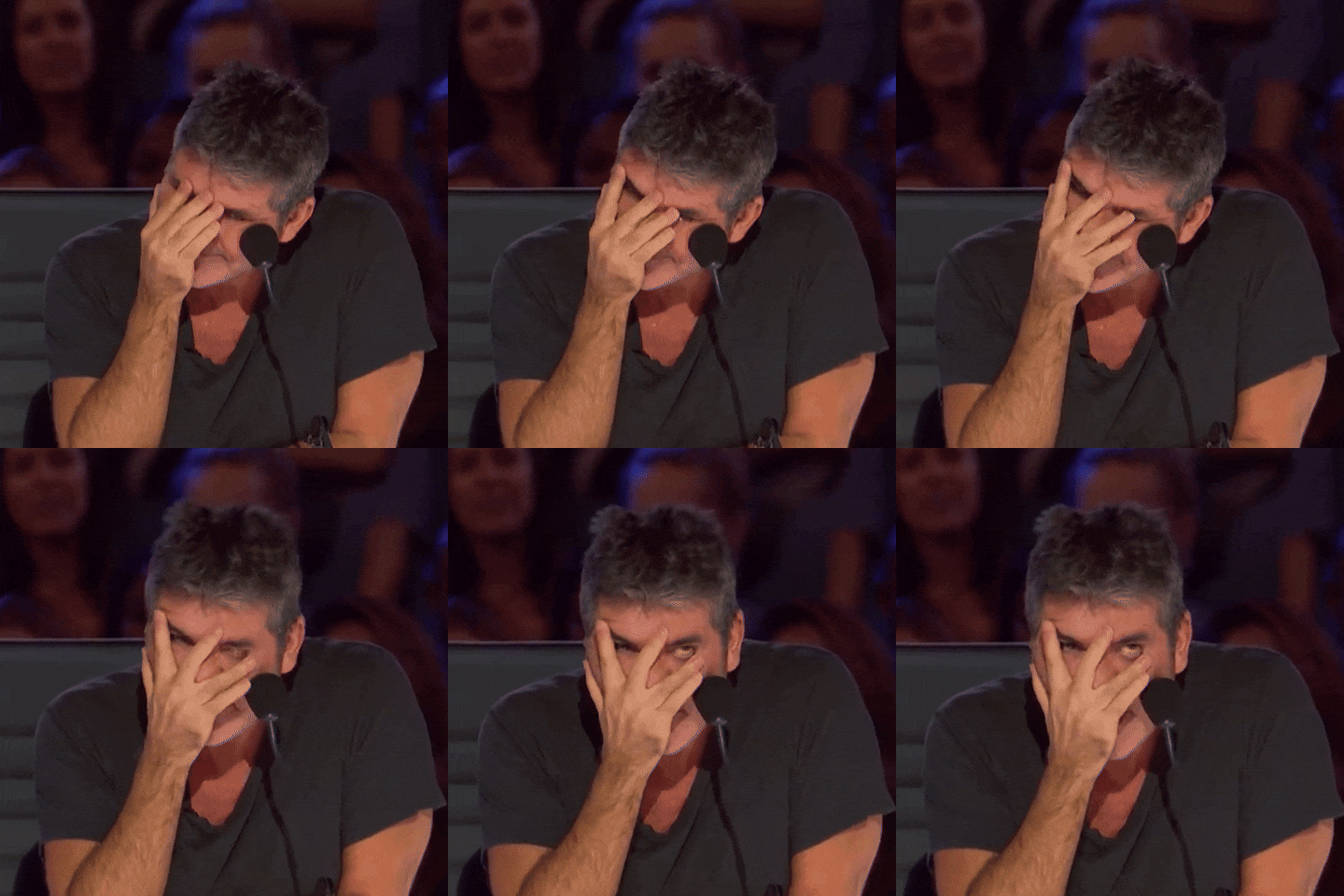
These are only a few examples of the many shows I have seen to be replicated across the globe. A great example is ‘Got talent’, which has been replicated in 58 countries. In fact, in 2014 the show originally founded by Simon Cowell in Britain, was “recognised by Guinness  World Records as the worlds most successful reality tv format” (Lynch, 2014). On searching Got talent on google, the first result that came up was a video posted on YouTube by ‘Britain’s got talent’ of a girl named sacred Riana. Sacred Riana originally entered the Asia’s got talent in 2017, where she wowed (freaked out) the judges. She is someone I had seen before on YouTube having sat with my parents who had seen it on Facebook and were absolutely in awe of her performance. Her first audition saw her reaching “650 million views on YouTube, which is more than any Got talent star in the world” (McIntyre, 2019). She has also been described by Simon Cowell as the “scariest act ever” as she brought her act over to Britain’s got talent only this year. Due to the global platform provided by the numerous media access we are exposed to, she has become a global sensation.

It wasn’t like this in 1975 when my Uncle David Mckay competed and won the Australian remake of ‘Opportunity knocks’. At the age of 14, a boy soprano, he won the show against adults. Therefore, won the opportunity to fly to England where the show originated, and he competed in their show. Although viewed in Australia on TV, there was no media coverage or video when he competed in Britain, due to no internet and media platforms like YouTube.

It’s hard to believe how far our global access has come over the many years. It’s become too easy for us to view whatever Tv show and movie we want to and whenever we want to. As stated in O’Shaughnessy’s article ‘globalisation’, “the most important points for media students to focus on include the relationship between globalisation and technological and economic changes in the media industries”. These days when the opportunity knocks, it’s not just a knock, it’s more like a bash.

References:

Lynch, K. (2014). Simon Cowell’s ‘Got Talent’ confirmed as world’s most successful reality TV format. [online] Guinness World Records. Available at: https://www.guinnessworldrecords.com/news/2014/4/simon-cowells-got-talent-confirmed-as-worlds-most-successful-reality-tv-format-56587/ [Accessed 28 Aug. 2019].

McIntyre, C. (2019). Britain’s Got Talent 2019: Amanda Holden terrified by ‘scariest act’ ever. [online] Newslanes. Available at: https://newslanes.com/2019/08/31/britains-got-talent-2019-amanda-holden-terrified-by-scariest-act-ever/ [Accessed 28 Aug. 2019].

O’Shaughnessy, M. (2012). Globalisation. 5th ed. [ebook] South Melbourne: Oxford University press, pp.458-471. Available at: https://tr.uow.edu.au/uow/file/e01a63f7-0d98-4c21-8b3b-9b259ada70a9/1/o%27shaughnessy-2012-458-471.pdf [Accessed 28 Aug. 2019].

BCM111

Crazy Rich Asians

Either because the roles haven’t been written, or the roles are marginal, Asian-American actors never get the chance to become A-list actors,”

Nancy Wang Yuen, Biola university professor and sociology chair
(lee, 2019)

Since the early 1900s, Asian representation in Hollywood film and television has been enormously lacking. “For decades, Asian Americans working in the film and television industry have carried the impossible burden of fixing a system that has tended to punish, stereotype and ignore them” states Karen K Ho in her journal ‘Crazy Rich Asians’. In fact, it isn’t until recently that Asian-American actors are appearing more frequently on the big screens specifically as lead roles in romantic/comedic films. Such examples can span from Netflix’s recent internet sensation ‘To all the boys I loved before’, that featured an Asian-American as the leading role, even becoming one of the most viewed Netflix movies in 2018. Another notorious movie released into cinemas August 2018, is “Crazy Rich Asians’, being “the first major contemporary-set release in Hollywood with an all-Asian cast in 25 years” as stated by Ashlee Lee in a 2018 ‘Bustler’ article.

Based off an already famous book, written by Kevin Kwan in 2013, this film was bound for success. Even before its release to the public, news articles such as the article “How Crazy Rich Asians is going to change Hollywod. It’s about time” (Time, 2019) had people buzzing with excitement to see it. Myself included. In fact, there was no targeted audience other than a global one. As a lover for any cliché movie with a the mixture of romance and comedy, this movie sounded perfect. Girl meets prince? Brilliant. Set in Singapore; even better. Did I use this weeks task as another excuse to watch it for the 100th time? I most certainly did. I believe that this movie is both entertaining and educational for all viewers. 

Kevin Kwan, the original writer of the best-selling novel, created a storyline that intertwined both American and Asian culture. Once you’ve been introduced to the many hints of both cultures throughout the entire film, it becomes clear just how cleverly written this whole book/film is. It provides a demonstration of a modernised version of traditional Eastern culture class systems. A class system that stems from outrageously rich families, well-to-do families, and the working class. We are first introduced to Rachel Chu, an economics professor, brought up in the American working class by her single mother from Chinese descent. She considered her partner Nick Young, a foreign student from Singapore, studying in America, to be a regular working-class man. Little did she know, Nick was a member of one of these so-called outrageously rich families, possibly considered royalty. It follows her journey to Singapore where she is introduced to a whole new different world of rich. 

Image result for crazy rich asians wedding

My understanding of Singapore’s wealth, development and culture was very limited and possibly a little stereotyped when thinking of an Asian country. However, through watching this film, it became clear just how little knowledge I had of just developed, modern and wealthy Singapore is. The class system demonstrated throughout this film can also be viewed as almost identical to a typical American class system. These ideas link this film to this weeks topic of hybridisation where a Hollywood film travels across the globe and is remade/remixed into another culture. What we see here is a cliché American storyline remixed into a film filled with culture, romance and extravagance beyond belief.

-T

References:

Bustle. (2019). Here’s What It Was Like To See ‘Crazy Rich Asians’ With An All-Asian Audience. [online] Available at: https://www.bustle.com/p/how-seeing-crazy-rich-asians-with-all-asian-audience-made-me-appreciate-the-movie-even-more-10139847 [Accessed 23 Aug. 2019].

HO, K. K. (2018) ‘Seeing Is Believing: What the Rise of Crazy Rich Asians Signals for the Future of Hollywood’, Time International (South Pacific Edition), 192(8), p. 40. Available at: https://search-ebscohost-com.ezproxy.uow.edu.au/login.aspx?direct=true&db=f6h&AN=133108639&site=eds-live (Accessed: 1 September 2019).

Lee, C. (2019). ‘It’s not a movie, it’s a movement’: Crazy Rich Asians takes on Hollywood. [online] the Guardian. Available at: https://www.theguardian.com/film/2018/aug/11/crazy-rich-asians-movie-kevin-kwan-jon-m-chu-constance-wu [Accessed 18 Aug. 2019].

South China Morning Post. (2019). Crazy Rich Asians: how is the film different from the book?. [online] Available at: https://www.scmp.com/culture/film-tv/article/2160113/crazy-rich-asians-five-biggest-changes-book-kevin-kwan-films [Accessed 19 Aug. 2019].

Time. (2019). https://time.com. [online] Available at: https://time.com/longform/crazy-rich-asians/ [Accessed 26 Aug. 2019].